When Love and Distance Exist Together
The grief we rarely talk about when parents and adult children stop speaking
By This Thing Called Grief
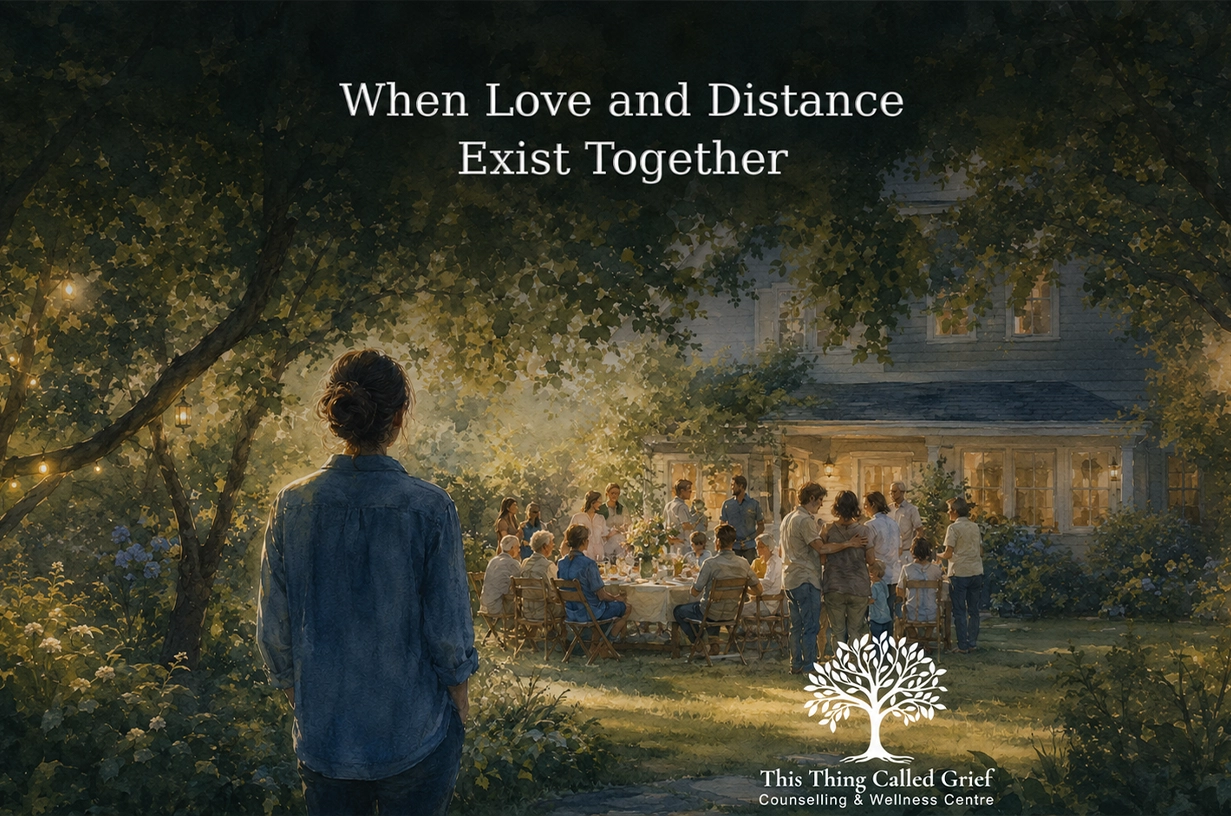
We talk about grief after someone dies. We understand the empty chair, the missed phone call and the ache of knowing someone we love is no longer here.
But what happens when they are still here, living their life somewhere, and you are no longer part of it?
What happens when an adult child decides they can no longer have a relationship with a parent? Or when a parent makes that decision about their child?
This is grief too.
It is a quiet and complicated grief because there is no funeral. No one drops off a casserole. There are no sympathy cards acknowledging that someone once woven through your everyday life is suddenly, or perhaps slowly, no longer there.
There is simply the phone that no longer rings. The birthday that passes. The empty place at the holiday table. And the question that may follow you everywhere:
Will we ever find our way back to one another?
Every family has its own story
Every family dynamic is as unique as any other loss.
Sometimes the reasons for stepping away are serious. Sometimes they are awful. Abuse, neglect, addiction, manipulation or years of ignored boundaries can make distance necessary. No one should be pressured to return to an unsafe relationship simply because someone says, "But that is your mother," or "That is still your child."
Love does not require anyone to continue being harmed.
But not every family arrives at estrangement in the same way.
Sometimes there was no single terrible event. There were hurts that never healed. Conversations where everyone spoke but no one felt heard. Someone waited for an apology. Someone else waited to be asked what happened. Pride moved in, and silence followed.
Eventually, everyone became so busy trying to prove they were right that they could barely remember what the original argument was about.
The hurt is still real. But perhaps there comes a time when we must ask ourselves:
Do I want to repair this relationship, or do I need to win the story of what happened?
Those are not always the same thing.
Grieving someone who is still living
Estrangement is rarely only about missing the person. It is also about grieving who they used to be, who we hoped they would become and the relationship we wished we could have.
A parent may grieve missed milestones and grandchildren. An adult child may grieve the parent they needed, the safety they did not feel or the hope that one day they would finally feel seen.
Sometimes both are grieving the same relationship from completely different sides.
One may remember trying their best.
The other may remember how much that best still hurt.
Both things can exist at the same time.
A person can miss someone desperately and still know that distance is necessary. They are not confused. They are carrying more than one truth.
Boundaries and new beginnings
A boundary does not always mean punishment. Sometimes it means, "I want a relationship, but I cannot continue having it this way."
A new beginning does not require anyone to pretend nothing happened. It may mean honest conversations, accountability, clearer boundaries and changed behaviour, not just changed words.
Sometimes a new beginning looks like reconciliation. Sometimes it looks like a smaller, more careful relationship. Sometimes it is an apology offered without the words "but you also..." attached to the end.
And sometimes the new beginning belongs to one person alone. It may mean accepting that the relationship cannot be repaired and choosing to build a meaningful life without allowing this loss to swallow everything that remains.
If this is part of your story, you do not have to pretend you are not hurting simply because the other person is still alive. You do not have to give up your boundaries to prove you love someone. And you do not have to stop loving them in order to move forward.
There may never be a version of the story where everyone agrees.
Sometimes healing begins with a conversation. Sometimes with an apology. Sometimes with a boundary.
And sometimes it begins when we stop asking who was right long enough to recognize what has been lost.
Because behind the silence, there is often more than anger.
There is history. There is hurt. There may still be love.
And there is grief.
If you are carrying the grief of family estrangement, you do not have to carry it alone. A counsellor or therapist who understands grief can offer a neutral space to explore the loss, create healthy boundaries and consider what moving forward might look like for you.
This Thing Called Grief
Sam Vander Schelde BSW MSW RSW, Thanatologist
Kim Vander Schelde, Grief, Bereavement & Loss Specialist, Thanatologist